
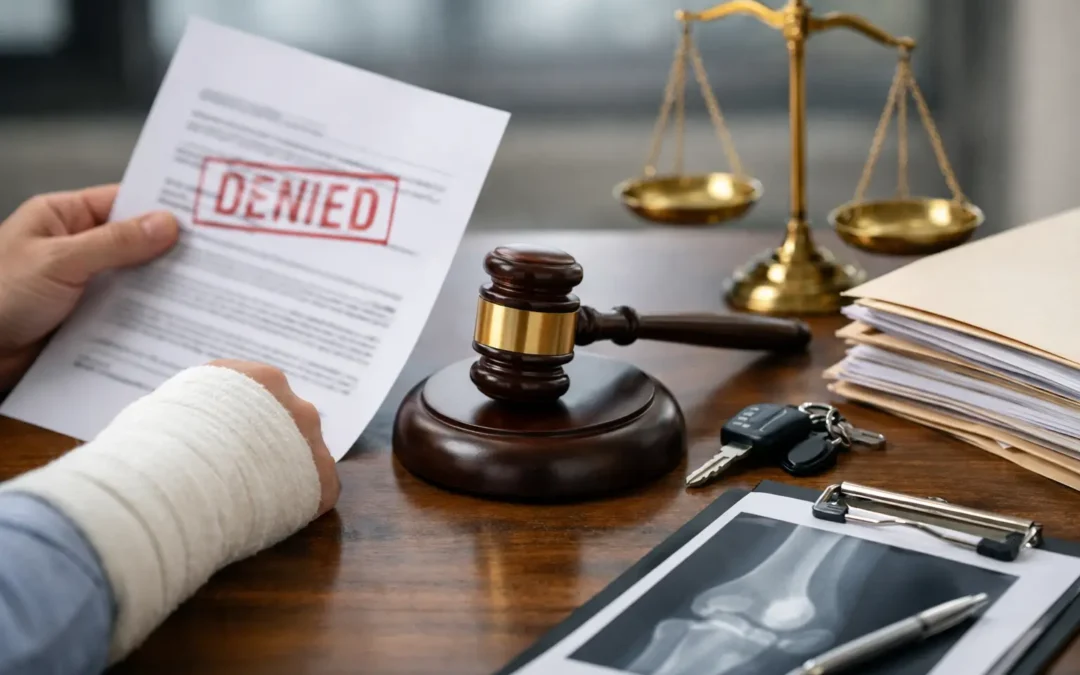
The letter may be short, but the impact is not. After medical appointments, missed work, car repairs, and calls from an insurance adjuster, a denied claim can feel like the insurer has decided your injury does not matter. It has not. The right steps after a denied injury claim can protect your ability to pursue the compensation you need for treatment, lost income, and the harm another person caused.
An insurance denial is not a court ruling. It is the insurance company’s position based on the information it has, the policy language it relies on, and sometimes its financial incentive to pay as little as possible. Before accepting that answer, slow down, preserve the record, and get clear about why the claim was denied.
Read the Denial Letter Closely
Do not rely on an adjuster’s explanation over the phone. Ask for the denial in writing if you have not received it, then read every page. The letter should identify the claim, state the reason for the decision, and often cite policy language or facts the insurer says support its position.
A denial may be based on a dispute over fault. The carrier may claim its insured did not cause the collision, that you were primarily responsible, or that there is not enough evidence to determine liability. In other cases, the insurer challenges whether your injuries came from the accident, argues your treatment was unnecessary, points to a coverage exclusion, or says the policy was not active.
Those are very different problems, and they require different responses. A denial based on an alleged lack of evidence may call for photographs, witness statements, surveillance footage, or accident reconstruction. A denial based on causation may require complete medical records and a clear account of your symptoms from the day of the incident forward.
Keep the letter, its envelope, every email, text, claim form, estimate, medical bill, and note from your conversations with the insurer. Write down the date, time, and name of anyone who contacts you. Details that seem minor now can become meaningful later.
Take These Steps After a Denied Injury Claim
Your first priority is your health. Continue medically appropriate care and follow your provider’s recommendations. Gaps in treatment can give an insurer room to argue that you were not seriously injured or that your condition came from something else. That does not mean every delay defeats a case – people miss appointments for real reasons, including pain, transportation problems, and work demands – but the reason should be documented.
Next, protect evidence before it disappears. Save photos and videos from the scene, damaged property, clothing, vehicle repair records, and receipts for out-of-pocket expenses. Preserve messages with the at-fault driver, incident reports, and names of people who saw what happened. For a fall at a business, prompt action can be especially critical because security video may be overwritten quickly.
If you were hurt in a car crash, obtain the traffic collision report when it becomes available and review it carefully. Police reports can help, but they are not always complete or correct. A report that does not list a witness or misunderstands how a collision occurred does not necessarily end the matter.
Avoid giving a recorded statement or signing broad medical authorizations simply because the insurer asks. You may need to provide information to advance a claim, but you should understand what is being requested and why. Broad authorizations can give an insurer access to medical history that has little to do with the injury at issue.
Do not post about the accident, your symptoms, activities, or settlement discussions on social media. Even an innocent photo can be taken out of context by a carrier trying to minimize your injuries.
Find Out Whether the Denial Is Final
Some denials are effectively an invitation to provide more information. Others are firm coverage positions that require a more formal challenge. The wording matters.
For example, an adjuster may deny a bodily injury claim because its driver says you caused the crash. That is a liability dispute, not necessarily a final answer. New witness evidence, vehicle damage analysis, dashcam video, or a stronger presentation of the facts can change the carrier’s evaluation.
A coverage denial is different. The insurer may say its policyholder was excluded, uninsured, using a vehicle outside the policy’s permitted use, or that a policy condition was not met. Coverage issues can be complicated, and the insurance company’s first interpretation should not be treated as the last word.
There may also be another source of recovery. Depending on the facts, that could include the at-fault party personally, another liable business or property owner, an employer, a rideshare company’s coverage, or your own uninsured or underinsured motorist coverage. Each possibility has its own rules, and not every case has multiple insurance policies available.
Do Not Let a Deadline Decide the Case
California injury claims are governed by deadlines, and waiting for an insurer to reconsider can be risky. In many personal injury cases, the general deadline to file a lawsuit is two years from the date of injury. Property damage claims often have a different deadline. Claims involving a government entity can require a formal government claim much sooner – commonly within six months of the incident.
There are exceptions and special rules for certain circumstances, including cases involving minors, delayed discovery, wrongful death, and claims against public entities. That is exactly why a denial letter should not sit in a drawer while you hope the carrier changes its mind.
Insurance policies can also impose notice, proof-of-loss, arbitration, or lawsuit deadlines, particularly in uninsured and underinsured motorist claims. A missed deadline can create a serious obstacle even when the underlying accident was not your fault.
Build the Case the Insurer Says Is Missing
A strong response is not simply a demand that the insurer be fair. It is a well-supported explanation of what happened, who is responsible, how the injury affected your life, and what compensation is justified.
Medical records should connect the incident to your symptoms and treatment whenever possible. This can be especially important with injuries that do not always appear clearly on an X-ray, such as concussions, soft-tissue injuries, nerve injuries, and chronic pain. Your own account matters too. Keep a simple record of pain levels, limitations, missed work, sleep problems, medications, and activities you can no longer do normally.
For lost income, gather pay stubs, tax records if you are self-employed, employer verification, and documentation of missed shifts or reduced duties. For property damage, keep repair estimates, photographs, rental-car expenses, and proof of the vehicle’s condition before the crash.
If the insurer is blaming you, do not assume partial fault means there is no claim. California follows a pure comparative negligence system. In many cases, an injured person may still seek damages even if they share some responsibility, although their recovery can be reduced by their percentage of fault.
Know When Legal Help Can Change the Pressure
A denied claim deserves careful legal review when injuries are significant, fault is disputed, coverage is unclear, a business or government entity is involved, or an insurer is pushing you to accept its answer without explaining it. The same is true when a family is facing catastrophic injury or wrongful death. These cases carry high stakes, and early mistakes can be difficult to undo.
A personal injury attorney can investigate the incident, identify potentially responsible parties and insurance coverage, preserve evidence, organize medical proof, communicate with the insurer, and file suit when that is the appropriate path. Filing a lawsuit is not necessary in every case, but the willingness and preparation to litigate can matter when an insurer refuses to evaluate a legitimate claim fairly.
At LionsGate Law Group, APC, injured people and families can request a free consultation to discuss a denial, the evidence available, and the deadlines that may apply. You should leave that conversation with a clearer view of your options, not more pressure.
A denial can be discouraging, especially while you are trying to heal. But an insurance company’s first no does not define what happened to you or what your case may be worth. Protect your records, protect your deadlines, and get informed support before you give up a claim that deserves to be heard.