Motorcycle accidents can happen in many different ways, and determining who is responsible is not always straightforward. Conflicting accounts, limited visibility, road conditions, vehicle damage, and the severity of a rider’s injuries can all make an accident investigation more complicated.
Motorcyclists may also face unfair assumptions that they were responsible simply because they were riding a motorcycle. However, fault should be based on the evidence surrounding the collision, not on assumptions about the rider.
In Sherman Oaks and throughout the San Fernando Valley, motorcycle accidents may involve left-turn collisions, intersection crashes, lane-splitting incidents, visibility problems, dangerous road conditions, or defective motorcycle components.
If you were injured in a motorcycle accident, determining which party may be legally responsible is an important part of pursuing a personal injury claim. A motorcycle accident lawyer can investigate the circumstances, preserve evidence, identify potentially responsible parties, and deal with insurance disputes.
How Is Fault Determined in a Motorcycle Accidents?
Determining fault starts with understanding how the Motorcycle Accidents happened.
For example, a driver who turns left in front of a motorcycle may have failed to yield the right of way. Similarly, a driver who changes lanes without seeing a motorcycle may be responsible if the evidence shows that the driver failed to exercise reasonable care.
Visibility can become particularly important in motorcycle accident cases. A driver saying that they did not see a motorcycle does not automatically establish that the motorcyclist was at fault.
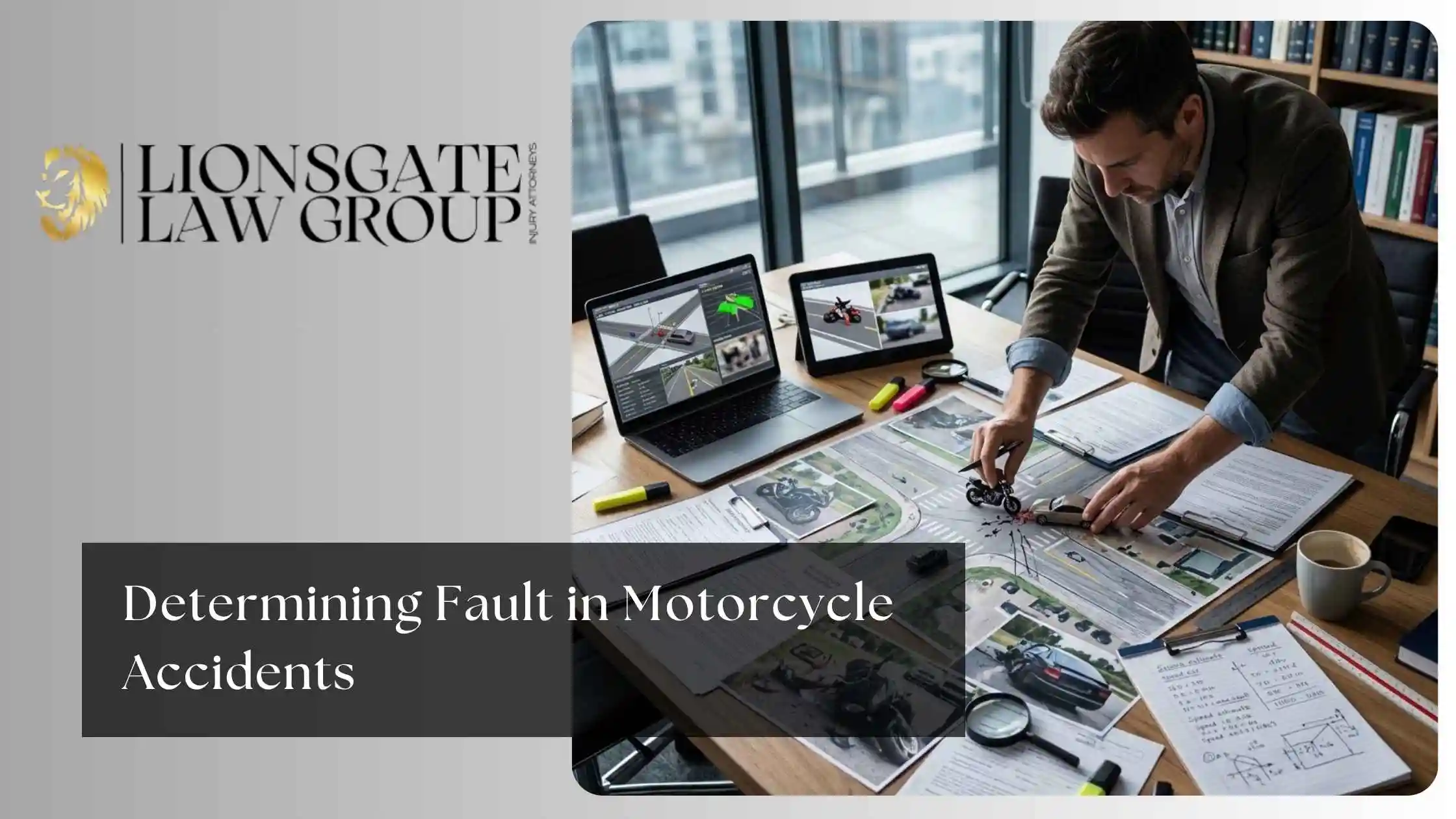
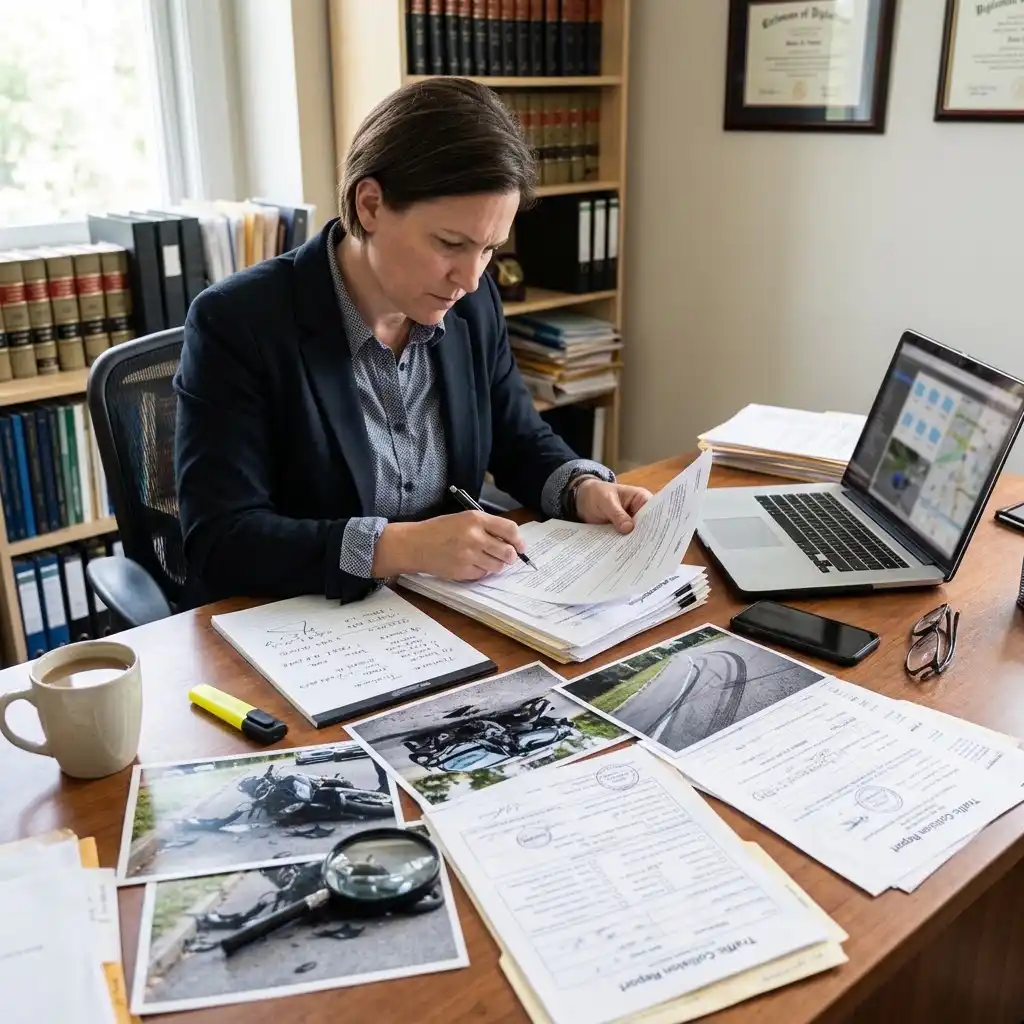
Evidence from the accident scene, vehicle damage, photographs, witness statements, police reports, traffic or surveillance video, and accident reconstruction can help establish what happened.
Lionsgate Law Group APC specifically handles motorcycle accidents involving lane splitting and visibility collisions and uses accident reconstruction evidence to address unfair assumptions about riders. The firm also handles left-turn and intersection crashes where a driver may have failed to yield to a motorcycle.
It is also important to remember that fault does not always rest with only one person. Depending on the facts, more than one party may potentially have legal responsibility for a motorcycle accident.
Parties That May Be at Fault in a Motorcycle Accident
Several different parties may potentially be responsible for a Motorcycle Accidents, depending on the circumstances.
The Other Driver
Another driver may be responsible when negligent driving causes the collision.
Examples can include:
- Failing to yield
- Making an unsafe left turn
- Changing lanes without properly checking for a motorcycle
- Distracted driving
- Failing to see a motorcycle
- Other unsafe driving behavior
Left-turn and intersection crashes are an important category of motorcycle accidents because a driver may fail to recognize an approaching motorcycle before turning across its path.
The Motorcyclist
A motorcycle rider can also potentially share responsibility for an accident if the evidence shows that the rider’s own negligence contributed to the crash.
However, an allegation that a motorcyclist was speeding, lane splitting, or otherwise riding unsafely should be supported by evidence. The fact that someone was riding a motorcycle does not by itself establish fault.
California’s comparative fault rules can also affect how compensation is determined when more than one party contributed to an accident.
Motorcycle Manufacturer or Parts Manufacturer
A defective motorcycle component may sometimes contribute to a crash.
For example, a mechanical or manufacturing defect could potentially cause a rider to lose control. In those situations, evidence may need to be gathered to determine whether a manufacturer or another party involved in the product’s distribution could be legally responsible.
Lionsgate Law Group APC identifies motorcycle defect claims as part of its current motorcycle accident practice and evaluates whether a manufacturer may share liability for a crash.
A Party Responsible for a Dangerous Road
A dangerous road condition can sometimes contribute to a Motorcycle Accidents.
Potholes, roadway defects, debris, inadequate maintenance, or other hazardous conditions may need to be investigated when they appear to have contributed to the crash.
Claims involving public entities can have additional legal requirements and deadlines, so these cases should be evaluated carefully rather than assuming that the government is automatically responsible.
Lionsgate Law Group APC’s motorcycle accident practice includes cases involving dangerous road conditions and evaluates whether a public entity may share responsibility.
A Party Responsible for Motorcycle Repairs
If a motorcycle was recently serviced or repaired and a problem with that work contributed to the crash, the repair facility or another responsible party may need to be investigated.
Maintenance records, invoices, photographs, damaged components, and expert evaluations may help determine whether improper service or another mechanical issue played a role.
Evidence Used to Prove Liability
Evidence is one of the most important parts of a Motorcycle Accidents investigation.
Instead of relying solely on statements from the people involved, an attorney may examine different sources of evidence to determine how the collision occurred.
Important evidence may include:
- Police or collision reports
- Medical records
- Photographs of injuries
- Photographs of motorcycle and vehicle damage
- Photographs of the accident scene
- Witness statements
- Traffic camera footage
- Dashcam or surveillance video
- Motorcycle repair records
- Vehicle inspection records
- Accident reconstruction evidence
- Insurance correspondence
- Documentation of lost income
- Records of medical expenses
Motorcycle Accidents Reconstruction Evidence
Motorcycle Accidents reconstruction can be particularly valuable when the parties disagree about how a motorcycle crash happened.
For example, reconstruction evidence may help analyze vehicle positions, damage patterns, roadway conditions, visibility, and other physical evidence.
Lionsgate Law Group APC specifically states that it uses accident reconstruction evidence in motorcycle cases involving visibility and lane-splitting collisions and in disputes where insurers attempt to blame the rider for injuries.
Medical Evidence
Medical documentation can also help establish the extent of injuries caused by a motorcycle accident.
Keep records from hospitals, doctors, specialists, physical therapists, and other healthcare providers. Medical bills and treatment records can document the immediate and continuing effects of the accident.
This evidence can be particularly important when an insurance company questions the severity or cause of an injury.
What If the Insurance Company Blames the Motorcyclist?
Insurance disputes can become complicated when an insurer argues that the motorcyclist was responsible for the collision or that the rider’s actions made the injuries worse.
For example, an insurer might focus on whether the rider was wearing certain safety equipment instead of addressing the conduct that actually caused the collision.
These arguments do not automatically determine liability.
Lionsgate Law Group APC’s current motorcycle accident practice specifically addresses safety-gear and equipment disputes by using accident reconstruction and medical evidence to focus on the cause of the crash and the actual nature of the injuries.
If an insurance company disputes your claim, avoid assuming that its assessment is the final determination of fault. A motorcycle accident attorney can review the available evidence and explain your legal options.
Why Legal Help Can Matter in a Motorcycle Accident
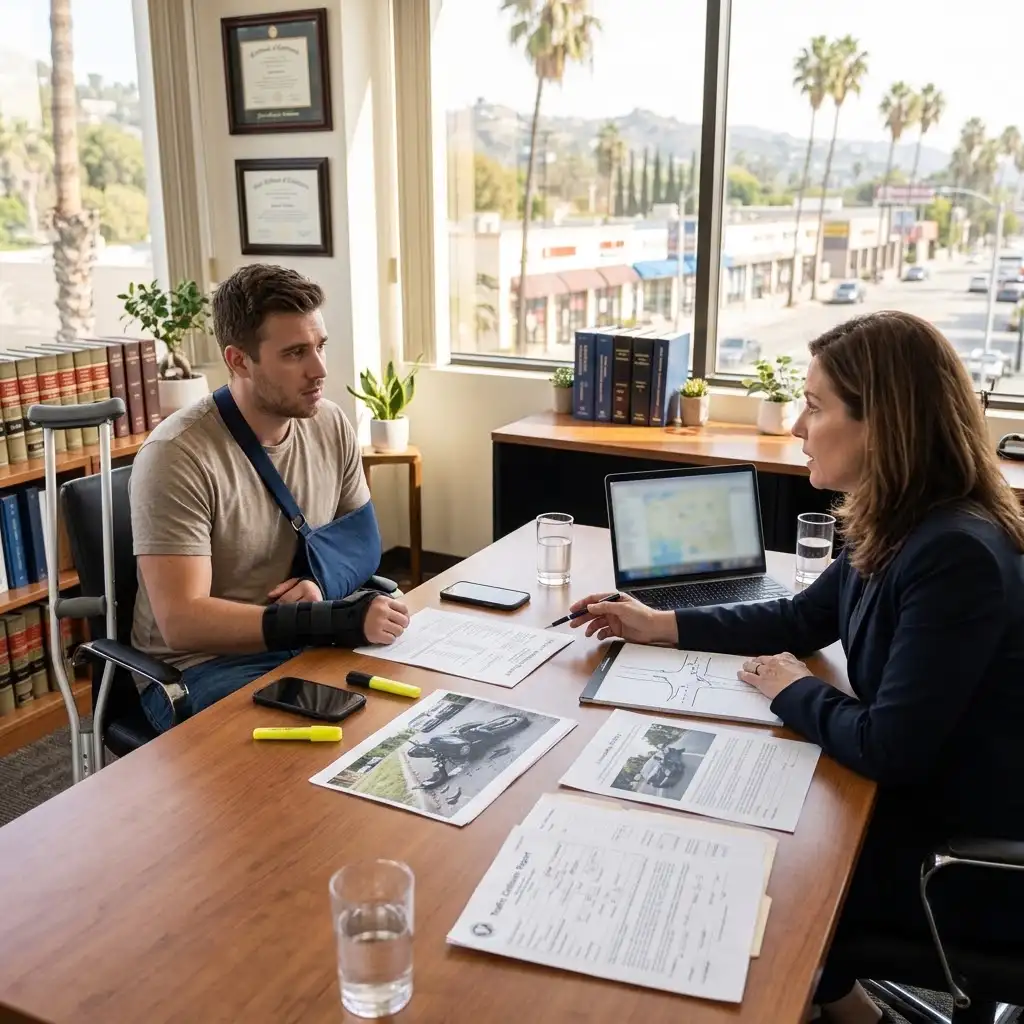
Motorcycle accident cases can involve more than determining whether another driver made a mistake.
An investigation may need to consider multiple potentially responsible parties, defective components, dangerous road conditions, insurance disputes, medical evidence, and the circumstances surrounding the crash.
A motorcycle accident lawyer can help preserve evidence, investigate liability, communicate with insurance companies, and pursue a claim based on the facts of the case.
Lionsgate Law Group APC is based in Sherman Oaks and represents motorcycle accident victims throughout Sherman Oaks and the San Fernando Valley. The firm’s current motorcycle accident practice covers visibility and lane-splitting collisions, left-turn and intersection crashes, motorcycle defects, dangerous road conditions, and safety-gear disputes.
Consult a Sherman Oaks Motorcycle Accident Lawyer
If you have been injured in a motorcycle accident, determining fault can be difficult, particularly when another driver or an insurance company disputes what happened.
The sooner important evidence is identified and preserved, the easier it may be to investigate the circumstances of the crash.
Lionsgate Law Group APC provides free case reviews for motorcycle accident victims. The firm’s Sherman Oaks office is located at 15303 Ventura Blvd, Suite 1050, Sherman Oaks, CA 91403, and the firm serves clients throughout Los Angeles County and California.
If you were injured in a motorcycle accident, contact Lionsgate Law Group APC to discuss your situation and learn about your legal options.
Call 818-574-5494 for a free consultation.